
International AI SEO Case Study · South Africa → USA
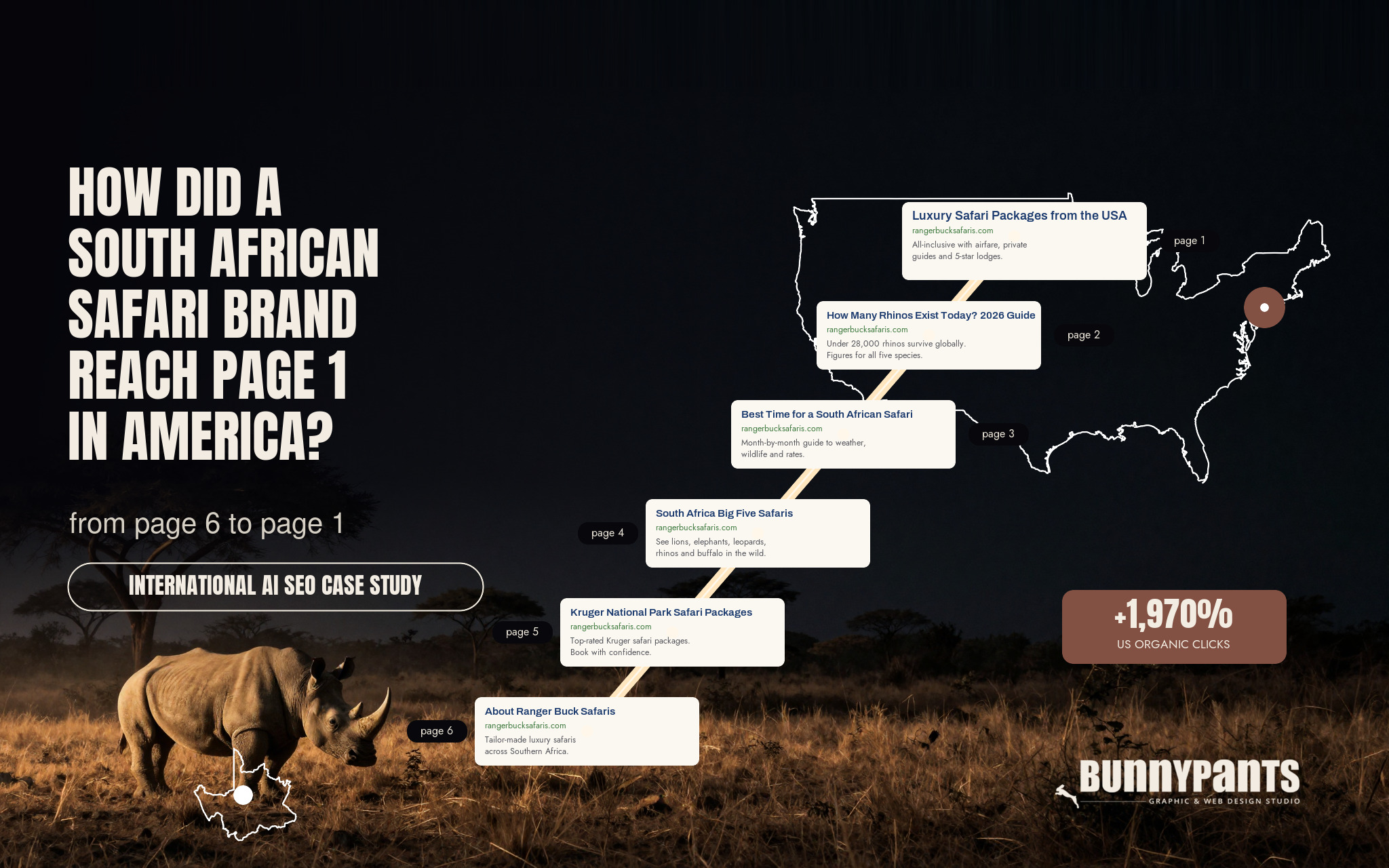
From almost invisible in the USA to page 1 — and into the AI's answers
Ranger Buck Safaris sells luxury safaris to Americans — but Americans couldn't find it. Sixteen months of pillar & cluster AI SEO put a South African brand at the top of page 1 in the United States, the UK, Canada and Germany — and made it a source that Microsoft Copilot and Google's AI cite when Americans ask who to book with.
Yes. Over 16 months, Bunnypants used a pillar-and-cluster AI SEO strategy to move Ranger Buck Safaris from an average Google position of roughly 57 (page 6) to page-one visibility in the United States. US organic clicks grew from 36 to 745 in the comparable four-month reporting window, total impressions passed one million, and the site's pages were displayed as cited sources 28,358 times across Microsoft's supported AI experiences over 180 days.
| Client | Ranger Buck Safaris — luxury safari operator |
|---|---|
| Client location | South Africa |
| Primary target market | United States |
| Secondary markets | United Kingdom, Canada, Australia, Germany, France, Netherlands |
| Main challenge | Almost no international organic visibility, competing against far better-resourced international operators |
| Strategy | Conservation pillar pages, supporting content clusters, internal linking and schema — then the same method aimed at commercial pages |
| Campaign period | December 2024 – April 2026 (ongoing) |
| Primary result | US page-one visibility; +1,970% year-on-year US clicks |
| Data sources | Google Search Console, Google Analytics 4, Bing Webmaster Tools |
| Next phase | Commercial luxury-safari clusters and USA / UK location clusters |
The problem
A South African budget, against international competition.
Ranger Buck sells custom luxury safaris into the USA. But the site sat around page 6 of Google in America — and on paid search it was competing against established international safari brands with vastly larger advertising resources.
Ranger Buck's entire paid budget at the time — roughly $1100. On US luxury-safari keywords, where clicks run around $10, that is a ceiling of about 110 paid search clicks a month — and most of the spend sat in display and video rather than search.
Google Ads auction data for the account showed Ranger Buck losing impression share to larger international operators in the overwhelming majority of auctions it entered. Not an estimate of anyone's budget — simply what the account itself reported.
There was one channel where the playing field could be levelled: organic and AI search. You can't outspend that kind of competition. You can out-answer it - with Ai SEO
The strategy
Don't chase the money keywords. Earn the authority first.
Instead of attacking competitive booking terms head-on, we built topical authority Google could not ignore: deep conservation content clusters — rhino, wild dog, then elephant, hyena and pangolin — each a pillar page surrounded by supporting pages, structured the way Google and AI engines actually read websites.
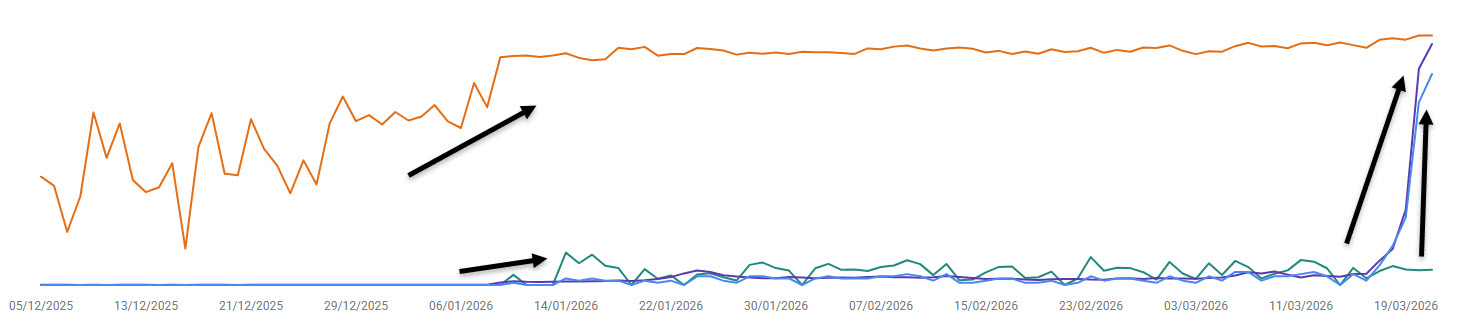
- Dec 2024 – Aug 2025Position 50–60 · the quiet monthsEight months on page 5–6 while the clusters compound in the background. This is the part of SEO nobody screenshots.
- Sep – Dec 2025Position 30 · the first breakThe Rhino pillar indexes. First sustained break below position 50 — onto page 3.
- Jan – Feb 2026Position 13 → 9 · authority compoundsThe site crosses into Google's top 10 for the first time.
- Mar – Apr 2026Position 6 · the breakout holdsTop of page 1 for two consecutive months. Every new cluster adds a rung to the climb.

| Metric | Value |
|---|---|
| Impressions | 1,040,000 |
| Clicks | 2,366 |
| Pages ranking | 24 |
| Average position | 5.2 |
The pillar effect
One pillar page came to rank for 200+ query variants — in five languages.
"How Many Rhinos Are Left?" — one deeply structured pillar page — reached position 1–2 for dozens of queries in English, French, German, Spanish and Polish, and at its peak drove 73% of all search traffic to the site.
| "How many rhinos are left" — the pillar query | 0 clicks · position 28.7 | → | Hundreds of clicks · position 4.3 |
| Conservation hub landing page | Not in the top 30 pages | → | #1 on the site · 14,009 sessions |
| US commercial packages page | Position 54 · page 6 | → | Position 4.2 · page 1 · 103× impressions |
| Homepage | Position 21.7 · page 3 | → | Position 9.7 · page 1 |
| Pillar page traffic | Did not rank | → | 1,742 sessions · 200+ query variants |
Like-for-like comparison: 15 December 2024 – 14 April 2025 versus 15 December 2025 – 14 April 2026. Source: Google Search Console (web search) and Google Analytics 4.
The AI proof · this is what AI SEO is for
The same pages that climbed Google are now cited by the AI itself.
When a US buyer asks Microsoft Copilot or Google's AI "which safari providers stand out for all-inclusive safaris?" — Ranger Buck's pages are increasingly the source the AI reads and cites. Measurably:
times Ranger Buck URLs were displayed as cited sources across Microsoft's supported AI experiences — Copilot, Bing AI answers and supported integrations — over 180 days, growing from 54 a day in January to 245 a day by July. Google's AI Overviews and AI Mode surfaces added 7,314 more across 87 distinct prompts. No ad budget can buy a single one.
Monthly citations from the Bing Webmaster Tools AI Performance report. *January is a partial month (tracking began 15 January 2026).
| Month | Citations |
|---|---|
| January 2026 (from 15th) | 897 |
| February 2026 | 2,104 |
| March 2026 | 3,456 |
| April 2026 (full-month pace) | ~5,300 |
| Total, 180 days to July 2026 | 28,358 |
What "citation" means here: Microsoft defines Total Citations as the number of times a URL is displayed as a source in supported AI-generated answers. It is not a ranking, an authority score, or a count of unique user questions — and a citation does not necessarily produce a website visit.
40% of the AI prompts citing the site are booking or trip-planning questions. The AI already treats Ranger Buck as a source for buyers — not just researchers. That is the "seasoned sales rep" effect: by the time a customer enquires, the AI has already introduced the business on its behalf.
On the numbers above: they are measured in Microsoft's and Google's own reporting tools. OpenAI publishes no equivalent per-site citation report, so we don't quote a ChatGPT figure — but we can show you a ChatGPT citation directly.
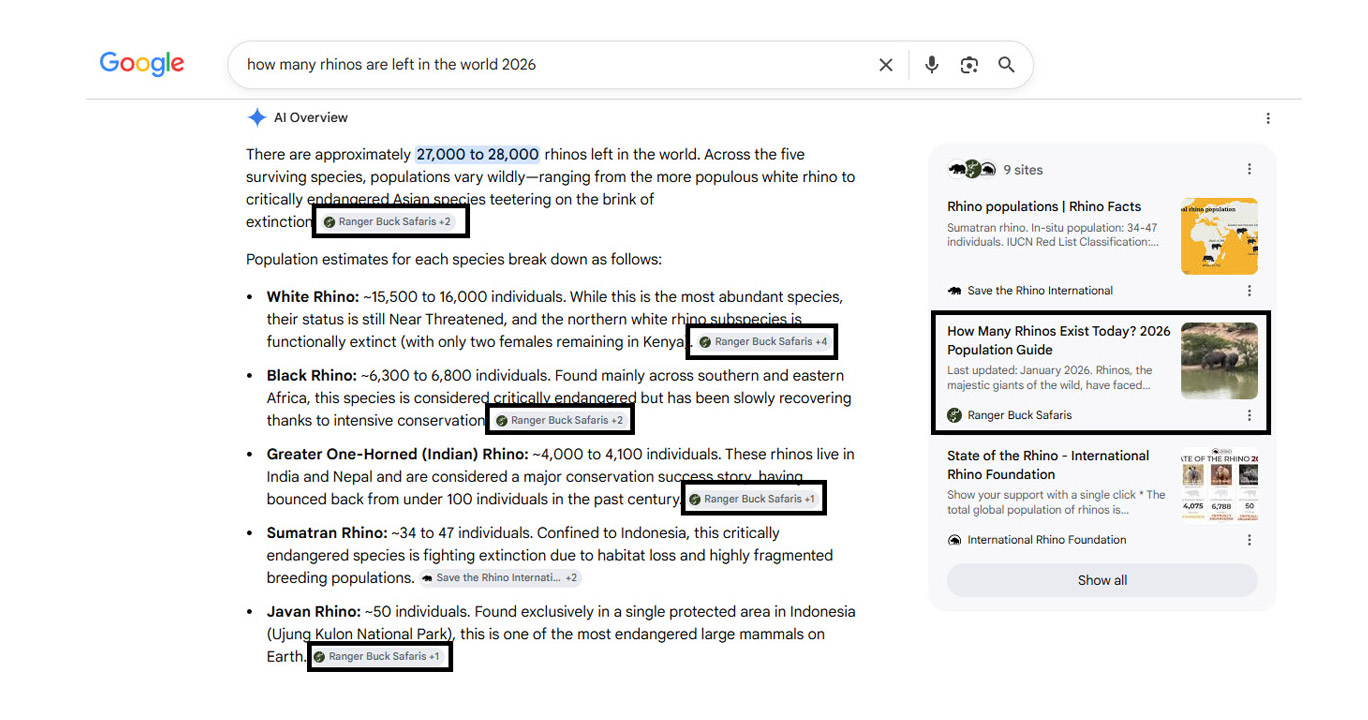
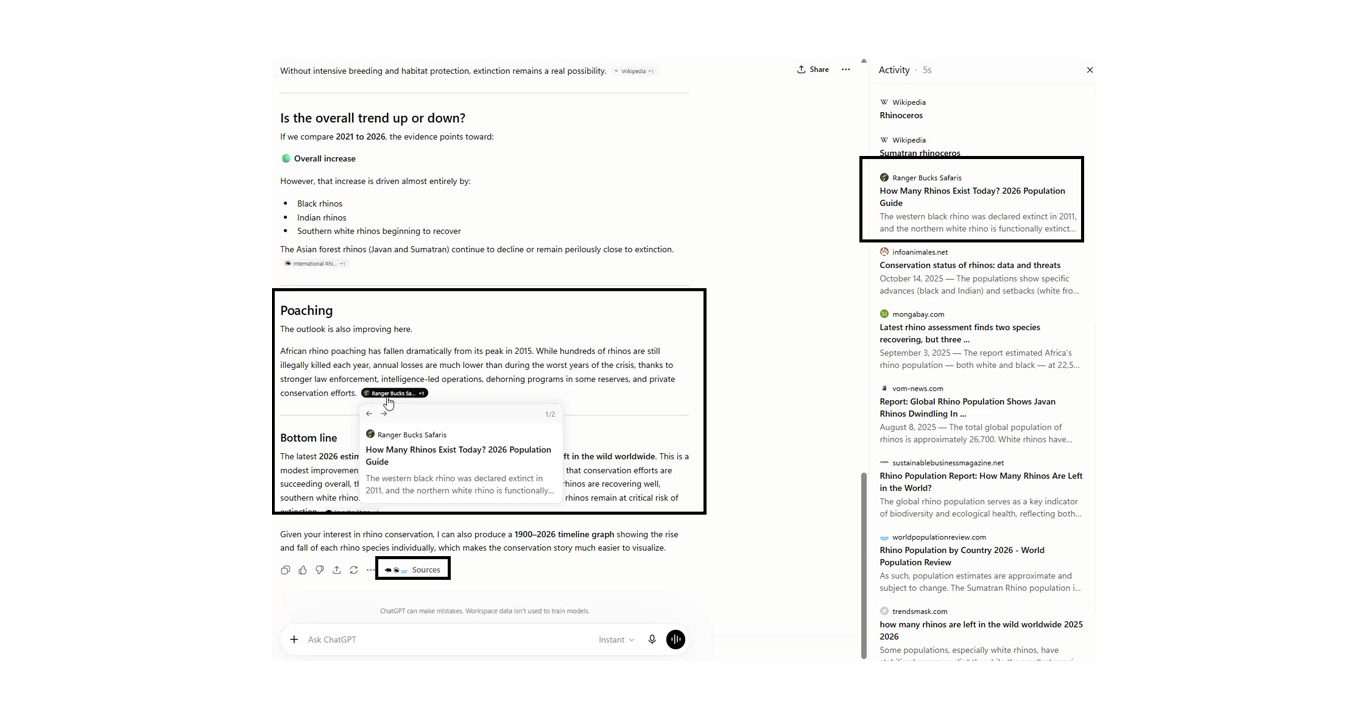
And ChatGPT, Ai Mode, Google Overviews cites them too — alongside Wikipedia and the IUCN
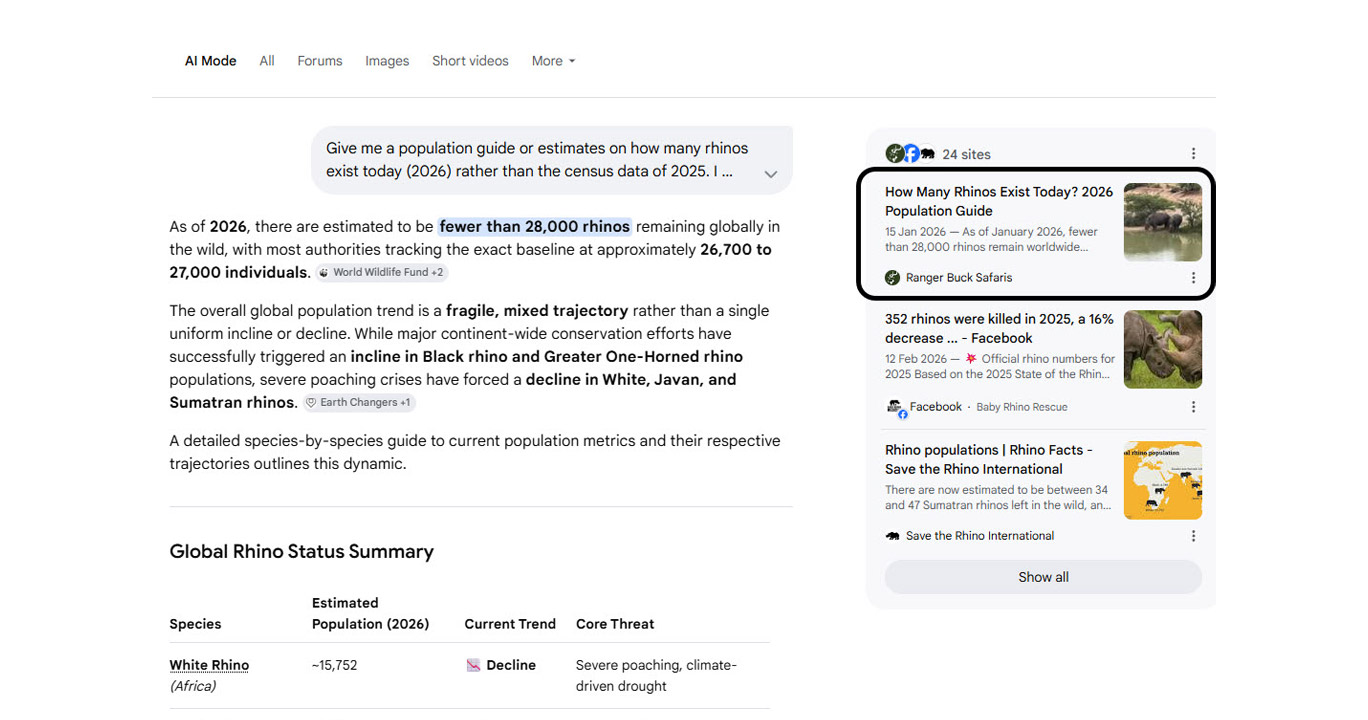
Look at the company the client is keeping. When ChatGPT answers a rhino conservation question, Ranger Buck's pillar page appears in its source list beside Wikipedia, Mongabay, the International Rhino Foundation and World Population Review — and its content is quoted inline in the answer itself. A safari operator, cited as a reference source next to the world's conservation authorities. That is what topical authority looks like from the outside.The AI Overviews citings are overwhelming. See the screen shots below.
Where measurement earned its keep
The data didn't just prove the work. It told us what to do next. And this was the breakthrough we were waiting for!
By mid-2026 the numbers showed a triumph with a warning inside it: two-thirds of all traffic rested on one informational rhino page — brilliant for authority, risky for a business. Meanwhile, 227,000 impressions on real booking queries sat stranded on pages 2–5, and one properly-built US booking page was already at position 5.45. So we told the client what the data told us: the conservation job is done — point the same engine at bookings!!!
The client reached the same conclusion from the same data. Having reviewed the engagement figures — organic visitors staying 4.4× longer than paid-ad visitors — Ranger Buck paused its Google Ads spend and redirected that budget into the organic build, effective from the end of July 2026.
From July 2026 the same cluster engine is aimed at what sells: luxury safari clusters and GEO-location clusters for the USA, then the UK — which has become the next commercial focus, with 147,000 impressions recorded at an average position of 11.9 during the measured period.And then the UAE. Watch this space for the results...
Read the receipts
The actual reports we sent this client. Unedited.
Every figure comes from Google Search Console, Bing Webmaster Tools and GA4 — all exportable from the client's own dashboards. We publish our reporting because the proof of the pudding is in the eating.
Methodology
How we measured these results.
Every figure on this page comes from the client's own dashboards and can be exported by them at any time. Here is exactly how each was produced — so you can judge the evidence, not just the headline.
Content work began in December 2024 and is ongoing. Results on this page are measured to 14 July 2026.
15 December 2024 – 14 April 2025 compared with 15 December 2025 – 14 April 2026. Identical length and calendar position, so seasonality is controlled for.
Performance report filtered to Country = United States, Search type = Web. Branded and non-branded queries combined. Desktop and mobile combined.
Site-wide average position across all indexed pages and all queries — not a single tracked keyword, and not a third-party rank tracker. Average position spans every query a page appears for, so it measures overall visibility rather than one ranking.
Country-level average position for the measured window: selected pages achieved page-one average positions for the queries they appear for in each market. Not a claim that every page ranks on page one for every query.
Page-level and query-level Performance reports, Web search type, for the windows stated above.
Default channel groupings, average engagement time per session, 14 December 2025 – 15 July 2026.
AI Performance report, 15 January – 13 July 2026 (data begins 15 January, when Microsoft made the report available). A "citation" is a URL displayed as a source in a supported AI-generated answer.
AI Overviews and AI Mode prompt data for the measured period. The 87 prompts are every prompt recorded for this site in that window — not a hand-picked selection.
Average engagement time per session by default channel group, same window. Paid figures cover the cross-network campaign running at the time.
AI citation reporting is new, and both Microsoft and Google may revise their methodologies. AI-generated answers vary between users, sessions and locations, so individual results are not always reproducible. Impressions and citations measure visibility, not revenue.
Every figure above is exportable from the client's own Google Search Console, Google Analytics 4 and Bing Webmaster Tools accounts.
Being straight with you
What this case study proves — and what it doesn't.
What the data demonstrates
- Substantial organic visibility growth over 16 months
- Page-one average positions in the USA and six other target markets
- Growth in citations across Microsoft's and Google's AI surfaces
- Organic visitors engaged 4.4× longer than paid-ad visitors in the measured period
- A repeatable method: five clusters, each following the same curve
What it does not claim
- That rankings are permanent — search results change constantly
- That every safari keyword reached page one
- That every AI citation produced a website visit
- That the same timeframe or outcome is guaranteed for any other business
- That impressions or citations equal bookings or revenue
Commercial outcomes: enquiry and booking figures are the client's confidential data. Where we are given permission to publish verified enquiry or conversion numbers, they will be added here with the date they were supplied. We would rather show you a gap than invent a number.
Straight answers
Questions about this case study.
- Can a South African business rank on Google in the USA?
- Yes. Ranger Buck Safaris moved from roughly page six to page-one visibility in the United States over 16 months, using an international pillar-and-cluster AI SEO strategy — with no US office and no increase in advertising spend.
- How long did the international SEO campaign take to work?
- The first sustained movement appeared after about eight to nine months (September–December 2025), when the site broke below position 50. Page-one visibility followed in January–April 2026. The early months showed very little movement — that is normal for content-led SEO, not a warning sign.
- What strategy was used?
- Bunnypants first built topical authority through conservation pillar pages and supporting clusters, structured with schema and internal linking. Once that authority lifted the whole site, the same method was aimed at commercial safari and location pages.
- Was the site cited by AI assistants?
- Yes — Ranger Buck pages were displayed as cited sources 28,358 times across Microsoft's supported AI experiences and 7,314 times across Google's AI Overviews and AI Mode during the measured periods, and we have documented ChatGPT citing the site's rhino pillar page directly. We don't publish a total ChatGPT figure because OpenAI provides no equivalent per-site citation report.
- Was all the growth from informational searches?
- No. Conservation content drove much of the authority and early traffic, but commercial package pages improved too — the US packages page went from position 54 to 4.2. The next phase deliberately shifts the focus toward commercial intent.
- Would this work for my business in a different country?
- The method transfers; the timeline and scale depend on your market's competitiveness, your site's current state and how many topic areas you target. That is what our free SEO analysis establishes before anyone commits to a package.
What level of financial investment is required for this kind of Ai SEO strategy and results?
There is no simple, one-size-fits-all figure. The required budget depends on the work already completed, the current strength of the website, and how Google, other search engines, and answer engines such as ChatGPT perceive the brand, its industry, its products, and its overall online authority. Before achieving its breakthrough, the RBS client invested approximately R30,000 per month—around $1,700—in SEO for three years. The client is now on our Expansion SEO Package, with a monthly investment of more than R50,000, or roughly $3,000. Following the improvement in organic search performance, part of the client’s previous Google Ads budget was redirected towards ongoing AI SEO growth.
When your customers ask Google or ChatGPT who to use — is the answer you?
Ranger Buck's story is the AI SEO method end-to-end: earn authority with clusters, let the whole site rise, get cited by the AI — then aim it all at the pages that sell. The same playbook works whether your market is Johannesburg, Cape Town, UAE, Gaborone or the United States.
View our AI SEO packages